Hot flashes at night
Hot flash triggers: a two-week evening test
Tick the evening habits you suspect, and the page plans a fortnight that changes one of them at a time, with a sheet to fill in each morning.
The National Institute on Aging and the NHS list alcohol, caffeine, spicy food, hot drinks and smoking as hot flash triggers. The NHS also tells you to keep the bedroom cool and to reduce stress. Only your own nights can show which of these matter for you, and the way to find out is to change one thing at a time and write down what happens.
The NHS advice for women who cannot take HRT says it plainly: make a note of your triggers and avoid them. The planner below does the organising for you. It picks two suspects, puts them in order and gives you fourteen dated rows to fill in.
Plan your two weeks
Tick every habit that is part of your usual evening. You need at least one.
How the two weeks work
Nights 1 to 4 are your ordinary evenings, so you know what a usual week looks like before you change anything. On nights 5 to 9 you drop your first suspect and keep everything else the same. On nights 10 to 14 the first suspect comes back and the second one goes. Each block differs from your usual evenings by one thing only, which is what lets you compare it with nights 1 to 4.
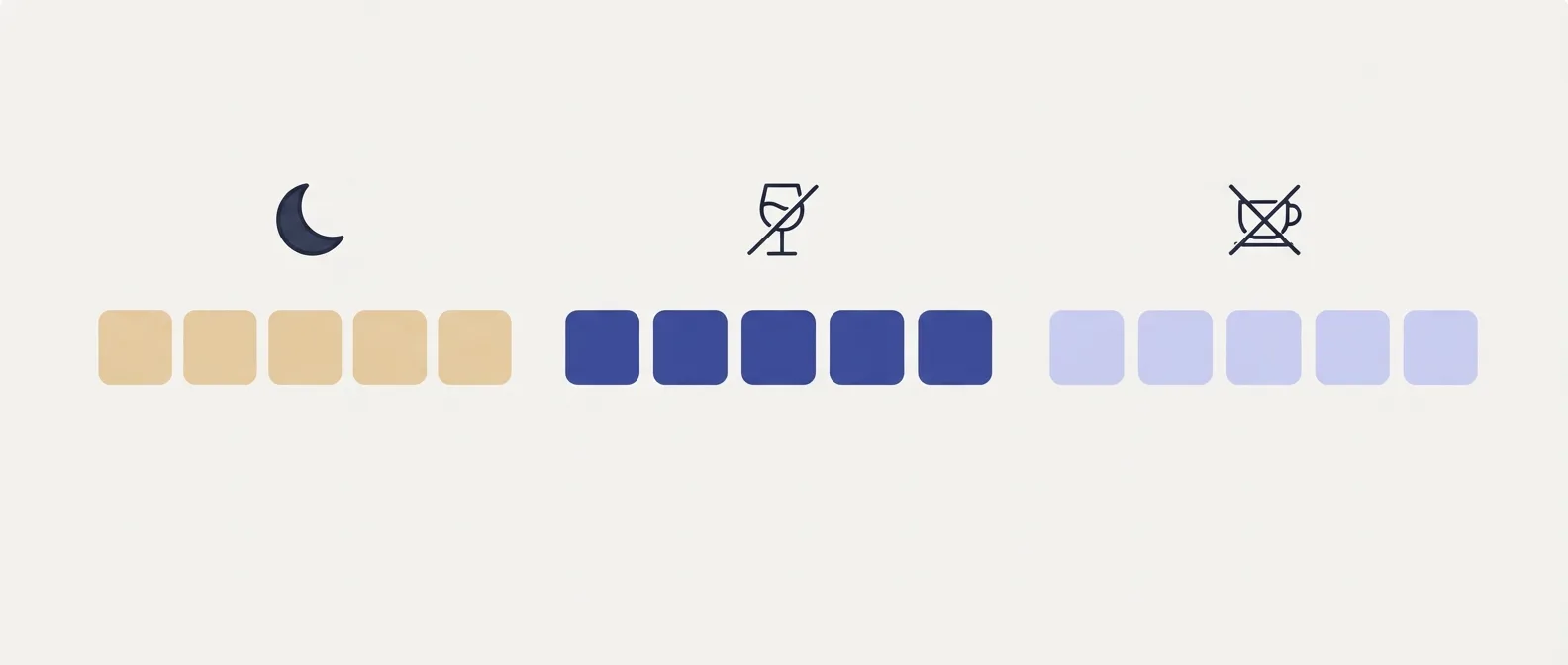
If you tick a single suspect, the plan drops it on nights 5 to 9 and brings it back for the last five. Flashes that ease and then return with the habit make a far clearer answer than five good nights on their own. Each morning, write down how many flashes you remember, grade the worst one as mild, moderate or severe, and note whether you woke soaked.
What is known about each suspect
Alcohol has the most research behind it. In a 2022 study of women aged 42 to 52 who had not yet reached menopause, the odds of hot flashes or night sweats rose with each step up in daily drinking. Compared with women who had never drunk, they were 1.42 times higher at under 10 g of alcohol a day and 3.52 times higher at 40 g or more. That study observed habits and did not ask anyone to stop, so it shows a link and leaves the cause open. The NIA adds that alcohol makes it harder to stay asleep, which matters on its own on a night already broken by heat.
For caffeine, a Mayo Clinic survey of 1,806 women found more bothersome hot flashes and night sweats among caffeine users after menopause, and the gap held after allowing for smoking and menopause stage. The difference was small, and the authors called the finding preliminary. Caffeine also lingers into the evening, which is why the plan cuts it from midday.
Spicy food and hot drinks are on the NIA and NHS lists on the strength of what women report rather than trials. They are also the cheapest to test: a mild dinner and a cold drink for five nights cost you nothing.
Room temperature is the easiest one to see. Under a duvet in a closed room, the heat of a flash has nowhere to go, and our guide to cooling a bedroom without air conditioning sets out the NHS steps. Stress is the hardest to switch off for five nights, so the plan asks only for the same quiet half hour before bed each evening.
Smoking is left out of the night-by-night plan. Both health bodies advise stopping, and a five-night pause is no test of a habit that affects the whole body. The NHS quit smoking service is the place to start.
Reading your sheet
Lay the three blocks side by side. Count the flashes in each and divide by the number of nights, then look at how many nights in each block had a moderate or severe flash and how many left you soaked. A suspect is worth taking seriously when its nights off are clearly quieter than nights 1 to 4 on more than one of those measures.
Expect some noise. Hot flashes come and go without any trigger, and the NIA notes research suggesting that waking itself may set a flash off. One bad night in a block means little. A pattern across five nights means more, and the same pattern on a second run means more again.
A worked example
Take a made-up reader who drinks a glass of wine with dinner, has a cup of tea in bed and sleeps with the heating on. She ticks those three boxes and names alcohol as her main suspect. She starts on a Monday.
Her plan runs four ordinary nights to Thursday, five nights without wine from Friday, then five nights with the wine back and the bedroom cooler. Hot drinks go on the list for the next fortnight. Say her sheet shows about three flashes a night in the first block, two on the nights without wine and three again once the wine is back with the cooler room. Then the wine looks like one of her triggers and the room looks like it matters less than she thought. With those numbers I'd keep dinner dry on weeknights and test the bedtime tea next.
My take
I'd start with alcohol if it is part of your evening at all. It has the clearest research link of the seven, and five nights without it is an easy thing to do on purpose. Caffeine comes next for anyone who drinks coffee after lunch.
Give the plan its four ordinary nights even if you are impatient to begin. Without them you will be comparing your new nights with a memory, and the women in one sleep-lab study reported fewer flashes than the sensors counted. For the sheet itself, the printable night diary has room for sleep and notes as well, and works for a fortnight alongside this plan.
If no trigger turns up
If two or three runs turn up nothing and the flashes still wake you, that is a fair point to talk to a doctor about the treatment options the NIA lists. The NHS advises seeing a GP when night sweats come regularly and wake or worry you, or come with a fever or weight loss you cannot explain, and our night sweats warning-signs checker goes through those signs. The hot flashes at night section gathers everything else we have on the subject, including the bedroom checklist for hot nights.
This planner sorts the suspects you tick into a schedule, using the trigger lists of the NIA and the NHS. It is an estimate of where to start, cannot tell you what causes your hot flashes and does not replace a doctor.